

MPLS vs SD-WAN: Which Is Right for Your Business?
MPLS and SD-WAN are two of the most common ways to connect multiple business sites, but they work very differently. MPLS is a private network run by a carrier. SD-WAN is a software layer that turns any mix of connections into one managed network. This guide explains each in plain language, compares performance, cost, security and cloud readiness, and shows how to choose, or combine, the two.
What is MPLS?
MPLS (Multiprotocol Label Switching) is a carrier-managed private network. When traffic enters it, each packet gets a short label that tells the network which path to take. Routers forward on the label instead of looking up the full destination at every hop, which makes forwarding fast and predictable.
MPLS has built-in Quality of Service (QoS). Traffic can be sorted into classes, such as real-time voice, business-critical and best effort, and each class gets guaranteed treatment across the network. That's why MPLS has long been trusted for voice, video and core business applications.
Strengths: predictable low latency and jitter, strong end-to-end QoS, a private network by design, and one carrier accountable for performance.
Limitations: higher cost per megabit than internet access, longer lead times for new sites, and less flexibility. Cloud traffic is often backhauled through a central data centre before reaching the internet, which adds latency.
What is SD-WAN?
SD-WAN (Software-Defined Wide Area Network) is a software layer that sits on top of your connections. Each site has an SD-WAN device that can use several links at once: dedicated internet access, broadband, LTE/5G or even MPLS. A central controller applies policies such as "send voice over the lowest-latency link" or "send Microsoft 365 straight to the internet".
The SD-WAN device constantly measures latency, jitter and packet loss on every link. It moves each application to the best path in real time, including failing over automatically when a link degrades.
Strengths: lower cost, fast zero-touch deployment, direct cloud and SaaS access, built-in encryption, central visibility, and easy scaling as sites are added.
Limitations: performance depends on the underlying links. Over the public internet, SD-WAN can steer around problems but can't guarantee end-to-end latency the way a private network can.
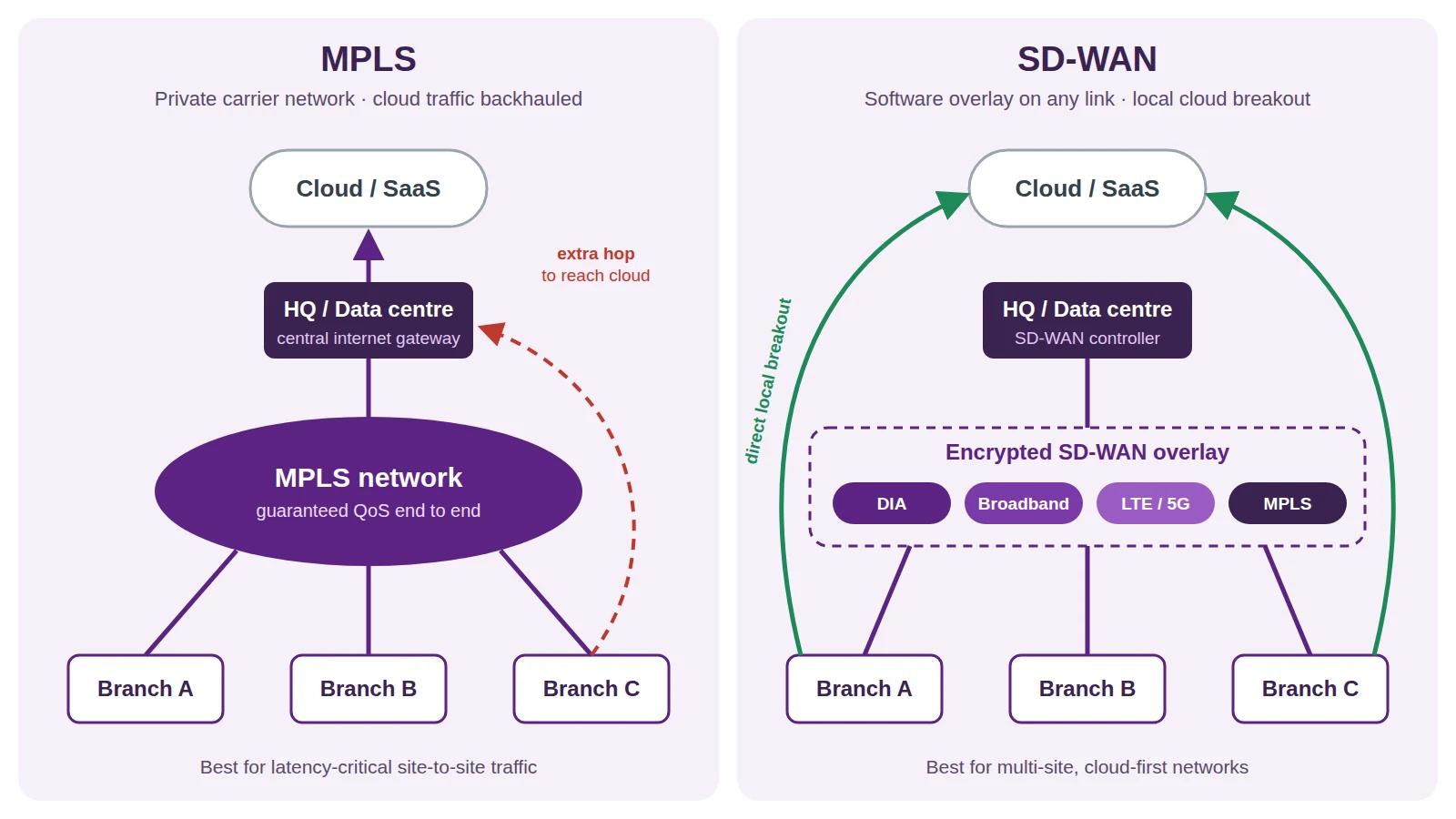
MPLS vs SD-WAN at a glance
| Factor | MPLS | SD-WAN |
|---|---|---|
| Network type | Carrier's private network | Software overlay on any transport |
| Performance | Predictable, low latency, guaranteed QoS | Application-aware; depends on underlay quality |
| Transport | Provider's MPLS core | DIA, broadband, LTE/5G, MPLS |
| Cloud and SaaS | Often backhauled via a data centre | Direct, optimised local breakout |
| Cost | Higher per Mbps | Lower and more flexible |
| Deployment | Weeks to months per site | Days, with zero-touch provisioning |
| Resilience | Depends on carrier design | Multiple links with automatic failover |
| Security | Private by design | Encrypted tunnels; integrates with SASE |
| Visibility | Via carrier reports | Real-time, per-application dashboards |
| Best for | Critical, latency-sensitive site-to-site traffic | Multi-site, cloud-first, cost-conscious networks |
Performance: where each one wins
For traffic between fixed sites that must never degrade, such as trading systems, voice trunks and data-centre replication, MPLS or a dedicated private line is still the benchmark. The whole path is engineered and guaranteed.
For cloud and SaaS traffic, SD-WAN usually performs better. Sending Microsoft 365, Salesforce or cloud workloads straight to the internet from each site avoids the extra round trip through a central data centre. Pairing SD-WAN with dedicated internet access rather than shared broadband closes much of the gap with MPLS, because the underlay is uncontended and SLA-backed.
Cost considerations
MPLS bandwidth usually costs more per megabit than internet access, and prices vary widely by country. SD-WAN lowers the cost of connectivity but adds licences and appliances. The real saving usually comes from replacing some or all MPLS capacity with DIA or broadband, and from managing everything centrally. Compare total cost of ownership over three years, not just monthly circuit prices.
Security
MPLS is private: your traffic doesn't cross the public internet. SD-WAN encrypts traffic between sites and can apply security policies at every branch. Many organisations now pair SD-WAN with SASE (Secure Access Service Edge), cloud-delivered security that protects users and sites wherever they connect. See the glossary for definitions.
Why not both? The hybrid approach
Many enterprises combine the two. MPLS or private lines carry the most critical traffic between core sites, while SD-WAN runs across every location. It uses MPLS where available and DIA, broadband or LTE/5G elsewhere. This keeps guaranteed performance where it matters and adds cost savings, cloud access and failover everywhere else.
A typical migration path:
- Deploy SD-WAN at all sites, keeping existing MPLS as one of its links.
- Add DIA or broadband at each site and move cloud and internet traffic to local breakout.
- Review MPLS usage. Reduce bandwidth or remove it at sites where the internet underlay performs well.
- Keep MPLS or private lines only for the few paths that truly need guaranteed performance.
How to choose
Choose MPLS (or keep it) if you run real-time or latency-critical applications between a small number of fixed sites, and predictability matters more than cost.
Choose SD-WAN if you have many sites, rely heavily on cloud and SaaS, add or move locations often, or want to cut network costs.
Choose hybrid if you have some critical site-to-site traffic but also a growing cloud footprint. That describes most multi-site enterprises today. Our multi-site connectivity page shows how we design these networks.
How Delta Communications helps
As a vendor-neutral provider, we design MPLS, SD-WAN or hybrid networks using the best carrier for each site. Every design is backed by a 99.9% uptime SLA, 24/7 NOC support and a single point of contact. Explore SD-WAN & Software-Defined Networking and MPLS & Ethernet Private Line.
Frequently asked questions
Is SD-WAN replacing MPLS?
In many networks it's reducing MPLS rather than replacing it outright. Critical links often stay on private circuits while everything else moves to SD-WAN.
Is SD-WAN secure enough for business traffic?
Yes. Traffic between sites is encrypted, and SD-WAN can be combined with firewalls or SASE for full security inspection.
Can SD-WAN run over MPLS?
Yes. MPLS can be one of the links an SD-WAN device manages, which is how most hybrid networks start.
Which is better for VoIP and video?
Both can carry them well. MPLS guarantees quality end to end. SD-WAN over good-quality DIA, with application-aware routing, delivers excellent results for most organisations.
Not sure which is right for your network? Talk to our network engineers.
Request a Quote